Thursday, March 2, 2023

Bay Area Real Estate Index Shows Downward Trend


The S&P CoreLogic Case-Shiller Index for single-family home values within the San Francisco Metropolitan Area – which includes the East Bay, North Bay and Peninsula – ticked down another 1.8 percent this past December and is now 4.2 percent lower than at the end of 2021, representing the largest year-over-year drop for the index over a decade.  In fact, the “San Francisco” index has actually dropped over 16 percent since last May and the decline is accelerating, none of which should catch any plugged-in readers, other than the most obstinate, by surprise.


At a more granular level, the index for the least expensive third of the Bay Area market ticked down 1.8 percent in December for a year-over-year decline of 4.7 percent; the index for the middle tier of the market ticked down 1.4 percent for a year-over-year drop of 3.9 percent; and the index for the top third of the market ticked down 2.0 percent for a year-over-year drop of 3.6 percent, as we projected.


The index for Bay Area condo values, which remains a leading indicator for the market as a whole, ticked down another 1.7 percent in December and was 4.6 percent lower than at the same time last year, having dropped 11 percent over the past seven months, versus year-over-year gains of 5.0 percent, 4.4 percent and 4.8 percent in Los Angeles, Chicago and New York, respectively.


At the same time, the national home price index only slipped 0.8 percent in December and remains “5.8 percent higher than at the same time last year,” with Miami, which remains 15.9 percent higher than at the same time last year, continuing to lead the way with respect to exuberantly indexed home price gains, followed by Tampa (up 13.9 percent) and Atlanta (up 10.4 percent), and the indexes for San Francisco and Seattle (down 1.8 percent) the only two major metropolitan areas having recorded year-over-year declines, but with an understated “cooling” across the board.

Sunday, February 26, 2023

Bay Area Median Rent Price Shows Slight Decrease


San Francisco and the rest of the Bay Area saw apartment rents fall in January at a higher rate than the national average, another sign of a slowing Bay Area economy that could be hurt further by mass tech layoffs.

San Francisco median rents fell 1.1% to $2,174 per month compared to December, one of the biggest drops in the country. Metro area rents are down 5% compared to March 2020 when the pandemic started, making San Francisco and San Jose the only two metro areas with more than 1 million people that have rents that are below pre-pandemic levels.

National rents fell for the fifth straight month, with prices down 0.3% compared to December. Prices are still up 3.3% compared to January 2022, but growth has slowed in the past two years. Two-thirds of the 100 largest U.S. cities saw rents drop month over month.


A wave of layoffs in tech is expected to reduce demand for apartments in the Bay Area. “Softness in the tech industry is likely to prevent a strong rebound in Bay Area rents,” Apartment List said.

Nationally, rents are expected to climb again during the busier spring and summer months.

Bay Area home values have also declined in the last 6 months as mortgage rates have shot up, according to Zillow.

Tuesday, July 12, 2022

Bay Area Home Prices Becoming More "Normal"


After two years of soaring home prices, the Bay Area housing market may have entered a cooling phase as rising mortgage rates put a squeeze on buyers.

But that doesn’t mean home values are suddenly falling back to Earth. Far from it. The median price of existing single-family houses in the region hit a record $1.36 million in May, a 13% increase from the same month last year, according to the latest data from real estate analytics firm CoreLogic.

Even so, housing experts say the breakneck pace of year-over-year price growth appears to have peaked – though few are predicting a housing crash on the horizon.

“We’re just seeing more of a normalizing to pre-pandemic conditions,” said Selma Hepp, CoreLogic deputy chief economist. “It wasn’t sustainable.”

CoreLogic forecasts annual home price growth in the Bay Area will decline to single digits by next summer. In other words, prices are still expected to go up across the region compared to the year prior, just not as quickly as before.


Hepp pointed to rising mortgage rates as a key factor. The cost of a 30-year fixed-rate jumbo home loan has in recent months jumped to around 5.7%, according to personal finance site Bankrate.com. For most of the Bay Area, a mortgage is considered jumbo if it’s more than $970,800. Though the 30-year rate has dipped the past few weeks, it’s still about double the roughly 3% historic-low charge available for most of the pandemic.

“Now that mortgages are much higher and the cost of ownership has gone up (significantly) from only a few months ago, it has had an impact on demand,” Hepp said. “With fewer buyers out there, what we’re starting to see is more price reductions and more homes staying on the market longer.”

In San Francisco, Santa Clara and San Mateo counties, that dynamic likely contributed to home prices falling slightly for the first time this year from April to May.

All three counties still saw large year-over-year gains: San Francisco increased 9% to $1.89 million, Santa Clara grew 18% to $1.8 million, and San Mateo was up 14% to $1.99 million.

Ramesh Rao, a real estate agent with Coldwell Banker Realty in the South Bay, said over the past few months he’s seen homes regularly going for under the asking price. That was unthinkable over much of the past two years as house hunters, many untethered from the office by remote work and seeking more living space, made all-cash offers and bid hundreds of thousands of dollars over asking in a mad scramble driving up home prices.

As the Federal Reserve is expected to continue raising borrowing costs to combat inflation, Rao said competition could soften even more.

“My advice to all clients if they’re sellers is: Today is better than tomorrow,” he said.

Friday, July 8, 2022

Hot Bay Area Housing Market Begins to Cool


Five of the 10 U.S. housing markets that have cooled fastest this year are in northern California–San Jose, Oakland, San Francisco, Sacramento and Stockton–and three of those five are in the Bay Area. All 10 of the housing markets cooling fastest are in the American West. The cooldown is largely because mortgage rates nearly doubled in the first half of the year, reaching nearly 6% in June. That caused the monthly mortgage payment for a typical homebuyer to surge 45% year over year to $2,459 in June and priced many buyers out of the market.

The cooldown comes after the housing market soared to new heights during the pandemic, largely fueled by record-low mortgage rates and remote work.

“The housing market has changed drastically in the last month because higher rates make homes even more expensive than they used to be. At the same time, fewer people can afford pricey homes because of the volatile stock market,” said San Francisco Redfin agent Joanna Rose. “In the early spring, every home was selling over its asking price with multiple bids. Then the number of people attending open houses dropped from 20 to two, and now some homes are sitting on the market for over a month and selling for under asking price. Supply is starting to pile up.”

Northern California’s housing market is cooling faster than anywhere else in the country

San Jose is cooling at the fastest clip, with measures of homebuyer demand and competition dropping off quicker than any other major metro this year. The supply of homes for sale in San Jose was up 10% year over year in May–but just three months earlier in February, supply was down 43%, indicating that buyers are now gobbling up fewer homes. And the share of homes that went off the market in two weeks was down 5% year over year in May, a big swing from the 22% year-over-year increase in February–that’s an indicator that homes are selling slower.

After San Jose, Sacramento is cooling fastest, followed by Oakland. Stockton, CA, located about 50 miles south of Sacramento, comes in at number five, and San Francisco is number 10.

The Bay Area is cooling quickly due to high mortgage rates, which hit pocketbooks harder in pricey areas, and the slumping stock market, a factor that’s particularly impactful in tech hubs where a lot of residents are compensated with equity. Sky-high home prices are another factor pricing many would-be buyers out of the market. San Jose, Oakland and San Francisco are the most expensive metros in the U.S., with the typical home selling for over $1 million and many selling for well over $1.5 million.

In dollar terms, mortgage rates reaching nearly 6% in the spring had a particularly big impact in pricey areas like Northern California. The typical monthly mortgage payment on a million-dollar home is roughly $5,750 with a 6% interest rate, $1,400 higher than it would be with a 3% interest rate (assuming a 20% down payment). The increase is half as big with a home priced close to the national median: The typical monthly payment on a $450,000 home is about $2,600 with a 6% rate, about $700 higher than with a 3% rate.

“But there is good news for some buyers. People who can afford to buy right now could get something for $100,000 or $200,000 less than a few months ago, largely because homes are often no longer selling above asking price,” Rose continued. “They’ll have a higher monthly payment for now due to the rise in mortgage rates but can refinance later if rates come down.

Monday, June 20, 2022

Nationwide Home Prices Begin to Cool


Home sellers are slashing prices as the housing sector cools, according to a research from a real-estate data firm.

More than 25% of homes on the market right now have cut their price, Altos Research found, which is in stark contrast to how prices have been climbing over the last two years. 

“Rising rates and the shift in the economy has slowed down the super-eager buyers,” Mike Simonsen, co-founder and CEO of Altos Research, a real estate analytics firm, told MarketWatch. “And what we’re feeling is the speed of the shift.”

Put bluntly: “We’re shifting from a real buying frenzy to much more normal conditions,” he added.

Adding to the cooling off: On Wednesday, the U.S. Federal Reserve raised the benchmark interest rate by 0.75 percentage point, the biggest increase since 1994 as it tries to tame rising inflation from a 40-year high.

The U.S. housing market boom amid the pandemic was felt across the country. In a high-demand area like San Jose, California, the typical home was valued at $1.5 million, as of May 31, according to Zillow. That’s up 23.7% from the previous year. In May 2020, the typical home in the Bay Area was valued at $1.09 million.

Under normal conditions, about a third of homes listed on the market for sale take a price cut before they’re sold, Simonsen explained, and when the market is hot, that drops down to 25%. This spring, however, only 14% of homes on the market took a price cut. And that’s a reflection of high demand and low inventory.

“Sellers in the last two years can overprice their home and still get offers — that condition of the frenzy is gone, so it’s a much more normal market,” Simonsen said.

With buyers slowly backing off, that percentage is now climbing, a trend also supported by research from Redfin, a real-estate brokerage. Some 21% of sellers dropped their list price during the four weeks ending June 5, which was the second-highest share on record, going back to 2015, Redin said.

Sellers will need to lower their asking price by summer’s end. “By July, expect to be back to our normal conditions nationally,” Simonsen added. “We’ve been hotter than normal for over two full years since the start of the pandemic. By August, sellers who aren’t prepared will be surprised.”

Good news for first-time home buyers

The median sales price of a house sold in the U.S. was still at a record high of $428,700 in the first quarter of 2022, up from $313,000 in the first quarter of 2019 before the COVID-19 pandemic, according to data from the St. Louis Fed. Simonsen said the magnitude of price cuts could vary, from $5,000 upwards, depending on the value of the house.

For first-time house buyers, who have seen prices gradually rise out of their reach over the last two years, there could be some relief. “If people want to buy a home, they would get outbid by maybe somebody with all-cash, or an investor,” Simonsen said. “But now, selection is increasing, competition is decreasing, and they finally have some opportunities to buy.” 

But don’t expect prices to hit rock-bottom just yet. “There is nothing in the data yet that shows an indication of home prices crashing,” Simonsen said. But “there is an indication of probably zero home price appreciation in 2023.”


Friday, January 29, 2021

Charts Show Just How Dramatic Bay Area Rents Declined in 2020


San Francisco’s housing rental market saw the most dramatic changes among all U.S. cities last year during the coronavirus pandemic, new data shows.

When the pandemic began in March, moving virtually halted across the country. But as job losses rose and workplaces went remote, people started leaving pricey big metro areas in favor of more affordable cities.

San Jose landed sixth on the list with a 15.2% drop since March and a median two-bedroom rent of $2,035, and Oakland was eighth on the list, declining 14.2% since March and a median two-bedroom price of $1,952. Apartment List estimates the median contract rent across new leases signed in a given market and month.

Rents in principal cities across the U.S., which are usually the largest or have the greatest economic output in the area, fell 9.3% since January, while rents in surrounding suburban cities increased 0.5% since the start of last year. The report reflected a big exception in the Bay Area: Both principal city San Francisco and its neighbor Oakland saw dramatic declines, though Oakland’s was somewhat smaller.


The pandemic also caused vacancies to rise in many large, pricey coastal cities. San Francisco saw a big spike in available apartments, which in turn pushed rental prices down. Apartment List’s local vacancy index more than doubled from 5% before the pandemic to nearly 12% by August.

“In turn, landlords had to drop their prices to attract the renters that were still interested in moving,” said Apartment List research associate Rob Warnock. “This phenomenon took place in many expensive cities throughout the country, but none more dramatic than San Francisco.”

Other cities including San Jose, Seattle, New York and Boston, had similar patterns. But some more affordable cities saw vacancies decline and rents trend upward, including Fresno; Albuquerque; Boise, Idaho; and Gilbert, Ariz.

Seasonal declines are normal this time of year, but Apartment List found the drop nationally in 2020 was slightly steeper than usual. The national rent index declined 0.4% from November to December, compared to 0.2% to 0.3% from the past three years.

“Rent declines in November and December are not unusual,” Warnock said. “Moving requires a lot of time and money, so during the winter months typically people direct those resources to holidays instead of moving. That said, in San Francisco, this season’s rent drops are steeper than previous years since the market was already in free fall going into this slower season.”

In 2019, rents in San Francisco decreased 0.9% in November and December. In 2020, they dropped 3.8% in November and 2.7% in December.

Monday, June 15, 2020

Median Home Prices Climbed in Bay Area Despite Corona Virus Restrictions


Eager buyers and reluctant sellers pushed Bay Area homes prices higher again in April, fueling quick sales and a robust market despite coronavirus restrictions.
Median sale prices climbed in seven core Silicon Valley and East Bay counties, according to a Zillow analysis. Prices jumped 7 percent in Alameda County and 6 percent in Santa Clara County from the previous April. The median sale price in April for a single-family home in the Bay Area was $896,000.

Fewer homes went up for sale as sellers pulled back from having strangers tour their houses, but buyers snapped them up at a pace rivaling the height of the housing boom in 2017 and 2018.
“The really big picture story is that prices, especially for single-family homes, have really held up during the crisis,” said Zillow economist Jeff Tucker. The relatively strong, tech-driven Bay Area economy, tight home inventory and historically low interest rates contributed to rising prices during the first full month of pandemic restrictions, he said.
The median price for a single-family home sold in April rose to $1.27 million in Santa Clara County and $940,000 in Alameda County. Other Bay Area counties saw smaller gains: Prices rose 3.1 percent to $1.49 million in San Mateo, 2.2 percent to $666,300 in Contra Costa, and 3.6 percent to $1.59 million in San Francisco. Data for Marin and Napa counties was not available for April, according to Zillow.
But buyers and sellers have remained cautious amid health risks. The volume of single-family home sales in Bay Area counties plummeted 21.4 percent in Santa Clara, 27.6 percent in Alameda, 10.7 percent in Contra Costa, and 22.9 percent in San Mateo from the previous year, according to Zillow. Single-family home sales in San Francisco were nearly cut in half.
The U.S. home market has been supported through the crisis by record-low interest rates. The rate for a standard, 30-year-fixed mortgage fell to 3.13 percent last month, according to Freddie Mac. The median price of a single-family home sold in the U.S. in April rose 4.3 percent from last year, according to Zillow.
Bay Area real estate agents say they’re surprised the market has sustained high prices through the lockdown. Local counties and the state have restricted home showings and real estate transactions since mid-March. Agents have gradually been allowed to show homes; at first, only vacant units but now buyers can tour occupied homes as long as residents are not present. Only two visitors may enter a home for sale with an agent at one time. Social distancing, masks and appropriate cleaning procedures are required. Open houses are still banned.
Many agents have turned to digital solutions, adding virtual 3-D tours to online listings and conducting video conferences with prospective buyers and sellers.
In some cities, the few homes that reached the market sold in just days, similar to the white hot trading of three years ago. Many cities in Contra Costa and Alameda counties saw houses sell weeks faster than in spring the previous year, according to data from Bay East Association of Realtors. Homes in Union City and Moraga spent an average of just 7 days on the market and 9 days in San Leandro. Houses in Hayward last April typically took 36 days to sell; this year, sales took just 11 days.
“It’s remarkable how much demand there is,” said David Stark of the Bay East Association of Realtors said. “People still want to buy houses.”
Los Gatos agent Mary Kay Groth said sellers have been weighing the risks of putting their homes on the market. Some agents have been vetting buyers to ensure only qualified and serious buyers make in-house visits, she said. In some cases, she said, “the process has been somewhat laborious.”

Thursday, June 11, 2020

Authentic Real Estate and Zero Tolerance


At Authentic Real Estate and Property Management we embrace a zero tolerance policy for inflammatory statements that spread hate, discrimination, intolerance and falsehoods against the black community.

Thursday, April 30, 2020

First Quarter 2020 GDP/Home Sales Numbers Released and Yes...It's Bad

The U.S. economy shrank in the first quarter, and it will almost certainly get worse. A weak read on pending home sales is a bad omen for April sales data. 

The initial read on Q1 GDP confirms what many already knew: Large parts of the economy came to a crashing halt in March, the economic expansion has ended and a recession is almost certainly underway. The negative quarter – the first since a 1.1% decline in the first quarter of 2014, and largest since the Great Recession – was driven by a severe pullback in consumer spending and trade-related metrics. Consumer spending, which comprises about 2/3 of the overall economy, fell 7.6% in the three-month span ending in March, with spending on services falling 10.2%. But as bad as these numbers appear, the second quarter’s figures are poised to be far, far worse. 
Today’s release predominantly covers a period that preceded the coronavirus outbreak and includes data from just the few weeks of the economic shutdown that largely began in March. Businesses in some states weren’t forced to shut their doors until late March or even early April, and subsequent slowdowns – including a sharp reduction in spending and an unprecedented surge in layoffs — barely register in today’s report, if at all. It’s also common for initial GDP readings to be revised downward, sometimes sharply, in times of economic volatility. The initial reading of annualized GDP growth in Q4 2008 – the middle of the financial crisis – was -3.8%, a level that was later restated to -8.9%. 
Taken together, it’s likely that today’s numbers will be revised downward when they’re restated next month, and that economic growth in the current quarter will plunge to levels not seen since the Great Depression. Even so, the housing market was a surprisingly positive note in today’s GDP release. The seasonally-adjusted annual rate of residential fixed investment, which includes spending on home construction, grew 21% from last quarter. 
The monthly decline in March pending home sales — to their lowest level since 2011 — was disappointing in some ways, but not unexpected. Overall, today’s reading was in line with other housing indicators that have emerged in the last few weeks. Pending sales typically lead the official reading of existing home sales by 4-6 weeks, and most experts already expect April’s existing sales figures to decline sharply. Pending sales figures are often viewed as a forward-looking indicator of the housing market, but in today’s fast-moving, unprecedented times, today’s release in some ways already feels like old news.
But other, faster indicators tell a somewhat more optimistic housing story. One of these is the weekly read of for-purchase mortgage application activity, which showed purchase applications rebounding over the week ending April 24 after falling in early April to their lowest level in almost five years. 
And these gains may be starting to accelerate. For-purchase applications still sit 19.8% below their levels from a year ago, but they were down 35% year-over-year just two weeks ago – a strong improvement in a short period of time. According to the Mortgage Bankers Association, the nation’s ten largest states saw an increase in purchase activity this week from last, with Washington, California and New York among those that saw a double-digit percent increase over that span. 
Low rates and changing lending criteria appear to be playing a role. Rates last week hit the lowest point ever recorded by the Mortgage Bankers Association, while strict lending criteria and preferences are making for more attractive rates for those looking to purchase a home rather than refinance. All told, it is an encouraging sign for the housing market, and may suggest that a possible upturn in the market is indeed underway.

Monday, April 6, 2020

First Signs of Slowing Housing Market Due to Economic Shutdown


In the weeks ending March 21 and March 28, the number of newly-listed properties fell by 13.1% and 34% respectively when compared with the same period a year ago, Realtor.com found. This is an indication that home sellers may be holding off on listing their properties right now.

The pace of home-price growth also slowed notably in the latter half of the month, according to the report. Home list prices were only up 3.3% year-over-year for the week ending March 21, and 2.5% for the following week. This represented the slowest pace of listing price growth since Realtor.com started tracking this data in 2013
“Our inventory and listing data can provide some early insight into how housing markets may be impacted by COVID-19, but the situation and reactions to it are still rapidly evolving,” Realtor.com chief economist Danielle Hale wrote in the report. 

“The U.S. housing market had a good start to the year. Despite still-limited homes for sale, buyers were buying and builders were building,” she wrote. “The pandemic and virus-fighting measures appear to be disrupting that initial momentum as both buyers and sellers adopt a more cautious posture.”
Real-estate firms have taken steps to brace for the impact of the coronavirus pandemic. So-called iBuyers including Zillow (ZG) and Redfin (RDFN) that purchase homes from sellers and then sell them for a profit had wound down their home-buying operations in anticipation of an economic downturn. Real-estate brokers, including Redfin and Re/Max (RMAX) , had also shifted toward virtual home tours as open houses became verboten in the wake of social-distancing recommendations.
And other recent reports have shown additional signs of a slowdown in the housing market. LendingTree (TREE) released a report of Google (GOOG)  search data analyzing the popularity of the search term “homes for sale” across the country’s 50 largest metro areas. Searches for “homes for sale” have fallen across all 50 cities in the study from their peak levels in 2020 thus far.
Another sign that home sales will slump this spring: Mortgage applications. The volume of mortgage applications for loans used to purchase homes was down 24% compared with a year ago for the week ending March 27, according to data from the Mortgage Bankers Association. That’s in spite of mortgage rates being near historic lows. Comparatively, the volume of refinance applications was 168% higher than a year ago.
Before the coronavirus pandemic flared up, the U.S. housing market was on relatively solid footing. While the number of homes for sale remained low — constraining sales activity to an extent — demand among buyers was still quite high. Low mortgage rates had fueled an early start to the spring home-buying season, with homes selling four days faster in March when compared with 2019 levels, Realtor.com found.
The jump in jobless claims has stoked concerns of a repeat of the Great Recession and the foreclosure crisis that preceded it. But housing economists argue that this is unlikely to be the case.
“While housing led the recession in 2008-2009, this time it may be poised to bring us out of it,” Mark Fleming, chief economist for title insurance company First American Financial Corporation (FAF) , wrote in a report this week. Unlike in the 2000s, the housing market in the U.S. is not overbuilt, Fleming argued, making it less likely that a large swath of vacant properties will crater the home values for homeowners. Rising home values and stricter lending standards have also meant that homeowners are sitting on historically high amounts of home equity.
“The housing market will not go unscathed, as consumer confidence and a strong labor market are essential in the decision to purchase a home,” Fleming wrote. “Yet, this time, housing is a casualty of a public health crisis turned economic, not the cause of an economic crisis.”

Monday, February 3, 2020

Bay Area Rent Cost Acceleration Forecast to Slow in 2020


After years of rapid growth, Bay Area rents continue to increase but are finally showing signs of a slowdown. That said, the region remains among the priciest in the country, and renting a one-bedroom is likely to cost over $2,000 in cities where jobs are plentiful, such as San Francisco, Oakland and San Jose.
Trends in the rental market are tricky to track, because a single clearing house of price data doesn't exist as it does with home sales that are entered into county recorders' offices. But at the start of a new decade, industry experts are noting the decline in the rate of growth in 2020.
Overall rent in the greater Bay Area in 2019 increased 1.2 percent year-over-year, marking the slowest rate of growth in more than two and a half years, according to Rent Cafe. This number was also under the 3 percent bump rents saw nationally.

Ken Rosen, chairman of the Fisher Center for Real Estate and Urban Economics at UC Berkeley, is noticing the slow growth, noting the breakdown of regional data from Yardi Matrix with a 2.6 percent year-over-year increase in San Francisco, 2.3 percent in the East Bay and 0.5 percent in San Jose.
"Several years ago, we had year-over-year growth exceeding 10 percent, so [this is] a sharp deceleration," Rosen said.
Rosen cites three main factors impacting prices. First, new supply is flooding the market, especially in Oakland and the Silicon Valley. Second, skyrocketing rents in the last decade mean the region has finally "reached a rent level that pushes against affordability ceiling for many households," he said.
Finally, a substantial increase in "out-migration," with people and jobs leaving the region, is making the market less competitive. "This is caused by high cost of housing, much higher effective tax rates, because of the new tax law limiting state and local income tax deductions, and the general deterioration of quality of life," Rosen explained.
Chris Salviati, housing economist with Apartment List, agrees that the 2019 data reveals the Bay Area market has flattened and noted that the region's allure as the best place in the country for jobs may be fading.
"Even though the economy remains hot in the Bay Area, a lot of other cities in other areas of the country have started to thrive," Salviati said. "There are burgeoning tech scenes in other cities. If you wanted that high-salary tech job, the Bay Area was once the only place to come. Now, other places can offer similar opportunities at a lower cost of living. It has become less attractive. That inbound demand is cooling."
But while the nine-county region and surrounding counties may finally be leveling off, there are still some areas where rents are seeing significant growth.
"When you look at the aggregated numbers, they all say there’s been a slight pull-down," said Doug Ressler, a business intelligence manager with Yardi Matrix. "What’s really happening is the suburban areas are pulling down the numbers. The central core is going like gangbusters."
The average San Francisco rent at the close of 2019 came in at $3,688, which was 2.1 percent higher than the same time last year. Oakland, with a median rent of $2,908, saw a 5.4 percent jump. Meanwhile, outside the core urban area, Richmond ($2,151) and Petaluma ($2,292) showed the most significant rent drops in the Bay Area — 7.8 and 2.7 percent year-over-year, respectively, according to Yard Matrix.
Despite the leveling off, Ressler said he expects the market to remain "very robust," especially in Bay Area cities.
"The Bay Area is landlocked," he said. "That core is a magnet for a workforce and a magnet for upper-median income. The supply has been limited, which has been allowing the rents to go up."

Tuesday, January 21, 2020

Good Advise If You Are Thinking of Selling Your Home in 2020


As 2020 gets going, it’s worth looking back at another year in which home sellers did well in some markets, but often at the expense of home buyers.
First, in much of the country, home prices rose again in 2019. According to the November Zillow Real Estate Market Report, home values grew an average of 3.8 percent, and the median home value in the United States is $243,225. The median list price per square foot in the United States is $154. The median price of homes currently listed in the United States is $284,999, while the median price of homes that sold is $236,900. The median rent price in the United States is $1,650.
In terms of inventory, homeowners continue to live in their homes and pay off their cheap mortgages. Why aren't they moving? That's still the big, unanswered question, and there doesn't seem to be consensus on the answer.
On a fundamental level, people move because they need something: more or less space, a yard, a particular school district, special services or proximity to work, family, friends or a house of worship. If a job is lost or won, and family income is affected, that could push a family to buy or sell property. If someone dies or is born, the change in the size of the family could do the same.
What seems to be happening is that people are working longer, so there’s no need to move for a job or retirement. And if your children haven’t settled down, married or partnered up and started having children of their own, you might decide to wait a few more years to see where they settle before deciding where you’ll settle in retirement.

If you’re thinking about selling in 2020, you should keep an eye on location and national trends. Millennials are starting to marry and have children. Where they decide to move could influence home values dramatically. Companies in the suburbs see more of their millennial and Gen Z employees staying in more diverse, urban areas and are either finding ways to make the commute by public transportation palatable (since these generations don’t love driving) or are moving back to the city.

Despite what’s going on in Northern California, the overall real estate market is slowing. In 2020, Zillow and the National Association of Realtors expect home price appreciation to slow down to around 2.2 percent. That’s a median number, so in places like Northern California, where millionaires are minted every time a tech company goes public and there aren’t nearly enough homes for everyone who wants them, you can expect to see home prices rise dramatically. In places like the North Shore of Chicago, in suburbs like Glencoe, Winnetka and Kenilworth, home values may shrink by 1 to 3 percent, or more.

In a presidential year, you would expect real estate to slow down a little bit. This, however, is the first presidential election year with full employment, almost historically low interest rates and a strong economy. It's possible that we'll look back in a year and say that 2020 was another strong seller's market.

Sunday, December 29, 2019

California’s 2020 Housing Market Forecast


California real estate market retreated slightly during November. Our updated report covers important stats including home prices, sales, and recent home sales trends from CAR, NAR,  Zillow and more. And we’ll take a look at the forecast for 2020.
CAR reports a slight decrease in the home prices and sales during November. However, we are moving deep into the off season, and buyers simply aren’t as active despite low mortgage rates and the recent plateau in home prices.
This is the 5th straight month of sales above 400,000 units (seasonally adjusted). November’s sales totals fell 0.3% from the October sales numbers (404,240), yet this is up 5.6% from last November’s total sales of 381,690. Realtors feel it was a good second half of 2019.
The median home selling price was $589,770, a drop of 2.6 % from October yet it that is still up 6.4% from November 2018.
Year to date sales are down 1.9% in November.
California Home Sales
In the San Francisco Bay Area, home sales grew 4.6%. Sales in the Bay Area itself saw sales drop 4.8%. Tehama saw the biggest growth in sales at 69.2%.
Year over year, median home prices have risen significantly during a troubled economic period. Southern California had a 7.5% rise, the Central Valley up 6.3%, Central Coast up 3.3%, while the Bay Area had only a 2.2% rise. The Bay Area housing market’s lower yield reflects the uncertainty in the tech sector.
Los Angeles County has seen prices rise 7.4% over the last 12 months, yet home prices fell $52,000 from October. San Diego county home prices rose 1.1% or $7000.
San Francisco saw it’s hot sales numbers cool significantly in November, dropping 20%. Home prices there dropped $31,000 or 1.9% in November. Marin and Napa counties saw price reductions of 9% or more from October. Sales in NAPA plunged 39%.
The Real Story of California Real Estate

The real story of California’s housing market is a persistent lack of supply, something that may never be remedied. That means overall home prices and perhaps rent prices might persist high as well.

Active listings fell for the 5th straight month, down 22.5% from last November. This was the 3rd consecutive double-digit drop and the largest since April 2013. Unsold inventory index dropped from 3.7 last year to this November’s rate of 3.0.
The sales to price ratio stands at 98.4%, up.5% from last November. Days to sell dropped to 25 days (-3 days).
A Paradox of Good and Bad
Given the low interest rates and corporate withdrawal of capital expenditures, it’s not surprising to see low job growth in tech, manufacturing and banking & finance.  Construction and administrative job growth was strong. Unemployment has fallen now to a record low 4.0%.
Yet homelessness and extreme housing costs are making life tougher for most Californians, particularly rental tenants.  Housing construction restrictions and other regulations are weighing very heavily on the quality of life in the Golden State and raising rent prices.
In what some expert economists forecast to be bearish times out west, it seems it’s going okay though.  If some projections of a growing US economy from 2020 onward come true, home prices may roar higher in 2020.
November Employment Numbers Were Excellent

Nationally, the jobless rate remained at a very low 3.6% while wages climbed 3%.  The California job market is still very good. Wells Fargo reports a gain of 23,000 jobs during October (up 1.8%) , and up 320,000 jobs over the past year.

California Association of Realtors believes low mortgage rates are the cause for this 3rd consecutive month of sales YoY, although prices over the last few months have remained the same.
The California Association of Realtors reports that sales of home priced between $500k and $1 Million rose about 15.5% on average. Sales under $300k dropped strongly (-14.7%) and homes above $2 million dropped 3.2%. Condos prices rose to $473,000.

The California Association of Realtors reports that sales of home priced between $500k and $1 Million rose about 15.5% on average. Sales under $300k dropped strongly (-14.7%) and homes above $2 million dropped 3.2%. Condos prices rose to $473,000.
Will California Recover in 2020?

Zillow says September’s median prices in California came in at $554,000 (which is up $4000 from October).  They had forecasted prices would only rise another $9k by next August.  If the economy should heat up, as some economists are now suggesting, it would create price growth of much more than $9,000.

Tight Conditions and a Rising Rent Environment

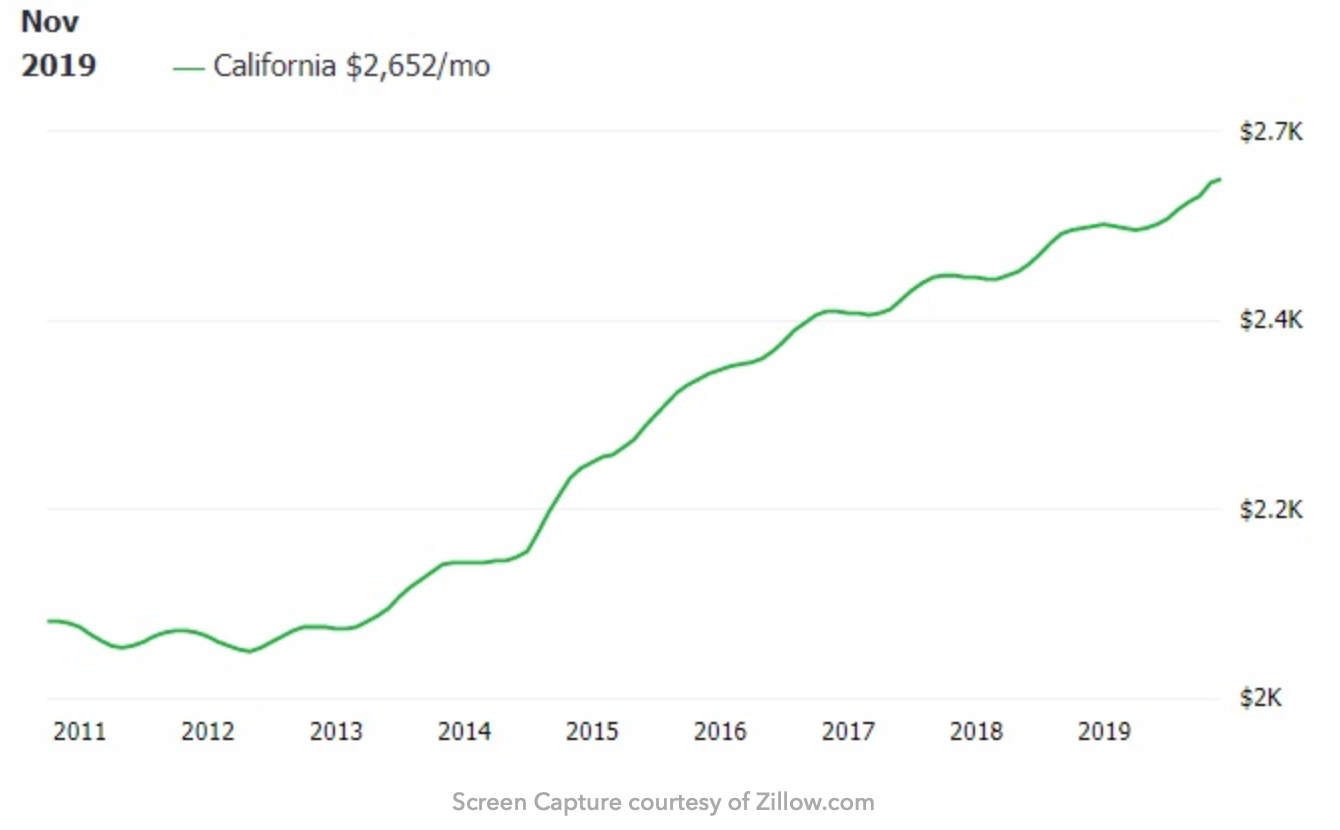
Despite lower mortgage rates, and flat home prices, it is likely California rents will rise. Unlike those in the national housing picture, Californians have solved the buy VS rent dilemma, by continuing with renting.  This is fueling a surge in build to rent developments.
Given the ultra-high real estate prices, first time buyers simply can’t come up with the downpayment or manage the lofty mortgage payments.  The rental market seems secure for landlords and investors. Rent grew slightly overall in the state.